IMPROVING YOUR DRIVING DISTANCE
Brandon Kowalick
2109590
HLPE3531
The golf swing is an extremely complex sequential state of
movements that come together to strike the golf ball in any given direction. An
athlete’s golf swing can have major technical differences from each other, but
still produce a similar result. Even with the major technical differences
present in many golf swings (both at amateur and professional level) the
biomechanical principles needed for the intended outcome are still the same. The
main biomechanical principles in play are: angular velocity, velocity, newtons
three laws, summation of forces, and the kinetic chain (Hume, P, Keogh, J &
Reid, D, 2005). Each principle plays a part in the four step swing phase. Newton’s
laws are featured the most throughout the swing, with each law being displayed
in a distinct phase of the swing of the club (Hume, P, et al., 2005).
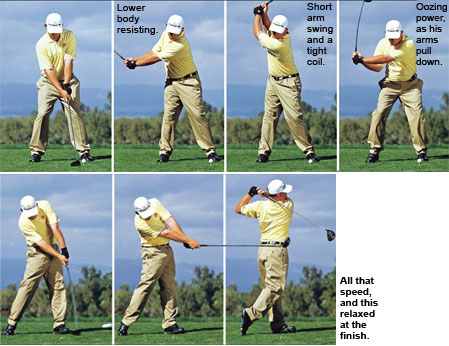
The golf swing can be broken down into four distinct phases.
The four distinct phases are: the address, backswing, downswing and
follow-through stages (Hume, P, et al., 2005). The address phase prepares the
golfer for their shot. The main aim of the address is to ready the golfer by
setting the player in good dynamic and static balance for a successful shot. The
grip is also paramount in this stage and there are three to choose from: Vardon
overlap grip, interlock grip or the baseball grip. Grip pressure can be strong
or weak. During the set up 50-60% of the players weight should be on their back
foot, with feet spread at shoulder width apart to give a stable platform to
swing from. Knees should have a slight bend, with the trunk of the player
flexed at 45 degrees which is the primary spinal angle (Hume, P, et al., 2005).
The next phase of the swing is the backswing.
The primary aim of the backswing is to provide the base link
for the downswings kinetic chain, and to ready the muscles and joints required
for generating the necessary power to execute the shot (Hume, P, et al., 2005).
The club head should follow a perpendicular line to the toes of the golfer,
with the shoulders and hips rotating sufficiently to allow this to happen. This
is the phase that begins the flexibility in the technical demands needed to
execute a successful shot (Hume, P et al., 2005) The club head speed used to
strike the ball powerfully begins its build up in this phase. Preceding the
backswing is the downswing.
The primary purpose of the downswing is to return the club
head to the ball with the maximum amount of velocity that can be controlled
(Hume, P, et al., 2005). The text book swing is described as having a single
fixed hub or rotation with a two-lever, one hinge moment arm to impact force on
the ball (Nesbit, S & Serrano, M, 2005). The centre of the hub lies at the player’s
sternum, and it acts as the centre from which the arm rotates around on a
specific plane; this is similar to a biomechanical wheel and axle system. The
downswing involves using the arms as a two-lever action. For a right handed
golfer the left arm in the important arm as it produces the action along with
the wrist with serves as a hinge. During the downswing the left arm provides
the plane that the club will follow, and the right arm provides the power in
the late stages of the downswing (Hume, P, et al., 2005). The energy build from
the summation of forces which is initiated from the legs and hips to the trunk
and shoulders to finally the wrists and hands is released.
The follow-through is the final phase of the swing. The
primary focus of the follow-through is to decelerate the body and the club head
using eccentric muscle contractions. The hands and wrist during the follow
through follow the plane of the swing path. The elbow flexion enables the
deceleration of the club head and trunk rotation. The goal is to finish in
balanced position with the body facing the target, the abdominal obliques
activate to help with stability (Hume, P, et al. 2005). This is why not just
golfers but all athletes focus on their core strength.
THE QUESTION
All golfers both professional and amateur wish to be able to
drive the ball longer off the tee. Through technique adjustments and
biomechanical principles it is possible to see how the body can generate more
power. How can a golfer increase their driving power to strike the ball
further?
·
Are there any additional injury risks?
THE ANSWER
The key for achieving maximum driving distance is reaching
maximum club head velocity during the downswing phase. Velocity is the change
of position of an object, which encompasses both the speed and direction of the
object (Blazevich, A, 2010). If the velocity changes in both direction and
speed, it is then going under acceleration. For example, if the golf ball
changes direction in the air as it veers to the left it is going under
acceleration due to forces acting upon the ball. This is Newton’s first law of
inertia.
To help achieve maximum velocity the cocking and uncocking
of the wrists is crucial in the downswing phase. The first stage of this
involves everything moving sequentially and together as a rigid body around a
rigid axis (Cochran, A & Farrally, M, 1994). This type of kinetic chain is
a throw like movement pattern. A throw like movement pattern involves the
joints involved sequentially moving, one after another (Blazevich, A, 2010). This
is present in the swing as the hips and legs move followed by the trunk and
shoulders, which then is released by the hands and wrists, creating angular
velocity. The timing of the uncocking of the wrist is paramount in the ability
to produce great club head speeds (Cochran, A & Farrally, M, 1994). For
optimum angular velocity the wrist should remain cocked until the last moment
(Hume, P, et al. 2005). This is a debate amongst golf coaches as do they
sacrifice control for power. With this movement the control of the swing
becomes less predictable. Studies have shown that the releasing of the wrist
late does improve distance (Hume, P, et al., 2005). The degree of wrist cocking
is one of the biggest variables when assessing the different levels of golfers;
the wrist cocking accounts for 60.3% of the total variance in club head
velocity between professionals and amateurs (Hume, P, et al., 2005). Affecting
the releasing of the wrists is the grip strength that is used.

Grip strength can be either strong or weak both with their
positives and negatives. The stronger the grip strength the ability to release
the wrists at the point of impact producing greater speed (Cahalan, T, 1991). The
weak grip reduces the amount of hand speed that can be created, but its
trajectory is more easily controlled. The stronger grip creates a lower margin
for error in the swing as it has a greater chance of hitting an off target shot.
The level of expertise should play a factor in the players grip strength.
Newton’s three laws play a large role in the execution of a
swing. The first law of inertia refers to the object (golf ball) relying upon a
force (golf club) to be able to move. Inertia is the reluctance of the body to
change its present state of motion (Blazevich, A, 2010). A product of linear
inertia is the moment of inertia which is angular motion. Angular motion is
proportional to the objects mass and the distance from the centre of gravity
(Hume, P, et al., 2005). The larger the object the harder it is to change its
velocity. This is present in the backswing as the golf club is angular and has
inertia which is cause by the mas of the club ad its distance from the centre
of gravity. The second law of acceleration is shown in the golf swing through
the change of momentum when the golf club makes contact with the golf ball. The
third law of every action has an equal and opposite reaction is present in the
ball striking phase of the golf swing. This is shown through the recoil felt
through the club immediately after impact.
Another benefit to releasing the wrists late is its ability
to create positive acceleration of the distal segment, at the expense of the
negative acceleration of the proximal system (Chu, Y, Sell, T & Lephart, S,
2010). The club head is the distal aspect as the club head is increasing in
acceleration. As mentioned earlier the wrist acts as an open hinge system
allowing for maximum angular velocity to be reached. The difference between
professional and amateur golfers is the added consistency that professionals
can generate. Skill cues are important
to help players track their technique to achieve their intended outcome.
HOW WE CAN USE THIS
INFORMATION
Increasing the overall driving distance of the player can be
attributed to small subtle changes to different aspects of the golf swing. One
particular skill cue is during the backswing bringing the golf club past
parallel (180 degrees). The trunk rotation that’s adds to the speed and
acceleration of the swing is more pronounced when the club is brought back past
parallel. Going past parallel creates greater inertia, and can create greater
force that can be applied to the ball. This comes with an added risk of injury
as low-back pain represents 40 – 50% of all golf related symptoms (Gluck, G,
Bendo, J & Spivak, J, 2008). The added rotation also creates greater torque
which means that the body has moved from its centre of mass losing its
stability. These co inside with the angular velocity of the club and their
effect on the principal planes and axis points of the body.

Moving the body away from the centre of the mass greatly
affects the stability of the object (in this case the golfer). To counteract
this problem of swinging the club and moving the player too far from their
point of stability the player can alter their set-up in before the swing has
taken place. As the driver is generally the heaviest club in the bag it is
harder to make a change in its motion due to its heavier mass. Therefore, in
the address phase of the swing instead of having a stance that is shoulder
width apart the player should slightly increase the between their feet. The
added stability can create a better platform for the golfer to launch from,
whilst still staying in their zone of their centre of mass.
To help with the release of the wrists at the point of
impact the golfer should look to practice pitch shots that require height. The
pitch shot pronounces the snap of the wrists just before impact due to the
difference in the club head. The club head is much more lofted, and lighter
than that of a driver. This difference can help younger golfers especially as
they might not have the physical strength yet to be able to control their wrist
action with a heavier club. In conjunction with the wrist action comes the grip
strength. To help the golfer grip the club stronger a smaller grip and/or shaft
of the club can be employed. This will help with players grip as the smaller
grip makes them grip the club tighter as without it the club will become very
difficult to control, even making them drop the club.
The key for driving distance is the cocking and uncocking of
the wist during the down swing phase. There are small skill cues which can help
accentuate the feelings required. However, the player must decide whether
striving for power is worth the sacrifice of accuracy and the increased risk of
back injury.
REFERENCES
Blazevich, A. (2010). Sports biomechanics the basics:
Optimising human performance. A&C Black.
Cahalan, T. (1991). Biomechanics of the
Golf Swing in Players with Pathologic Conditions of the Forearm, Wrist and
Hand. Journal of Sport Medicine. 19 (3) pp. 288-293
Cochran, A. & Farrally, M. (1994). Science and Golf II:
Proceedings of the World Scientific Congress of Golf. Taylor & Francis
Chu, Y., Sell, T. & Lephart, S. (2010). The relationship
between biomechanical variables and driving performance during the golf swing.
Journal of Sport Sciences. 28 (11) pp. 1251-1259
Gluck, G., Bendo, J. & Spivak, J. (2008). The lumbar
spine and low back pain in golf: a literature review of swing biomechanics and
injury prevention. The Spine Journal. 8 pp. 778-788
Hume, J., Keogh, J. & Reid, D. (2005). The Role of
Biomechanics in Maximising Distance and Accuracy of Golf Shots. Sports
Medicine. 35 (5) pp. 429-449
Nesbit, S. & Serrano, M. (2005). Work and Power Analysis
of the Golf Swing. Journal of Sport Science and Medicine. 4 pp. 520-533
